
In-person advanced training workshops and retreats for Corpus Christi LPC Associates and Counseling Interns
In-Person Workshops, Training & Professional Retreats in Corpus Christi
These in-person workshops and professional retreats are designed for Texas LPC Associates, counseling interns, nurses, mental health students, and other helping professionals—including LPC Associates who receive supervision outside of our practice.
Each gathering combines practical clinical education, professional development, and experiential learning in a setting created for reflection, connection, and growth. The goal is more than simply earning training hours. Participants have opportunities to learn, practice skills, ask questions, discuss real-world clinical situations, and develop greater confidence in their work.
Hosted in Corpus Christi, Texas, our setting offers space to gather, learn, move, reflect, share a meal, and reset. Depending on the workshop, participants may have access to a conference area, kitchen, yoga and movement space, sanctuary, and surrounding grounds, allowing us to incorporate experiential learning alongside traditional professional education.
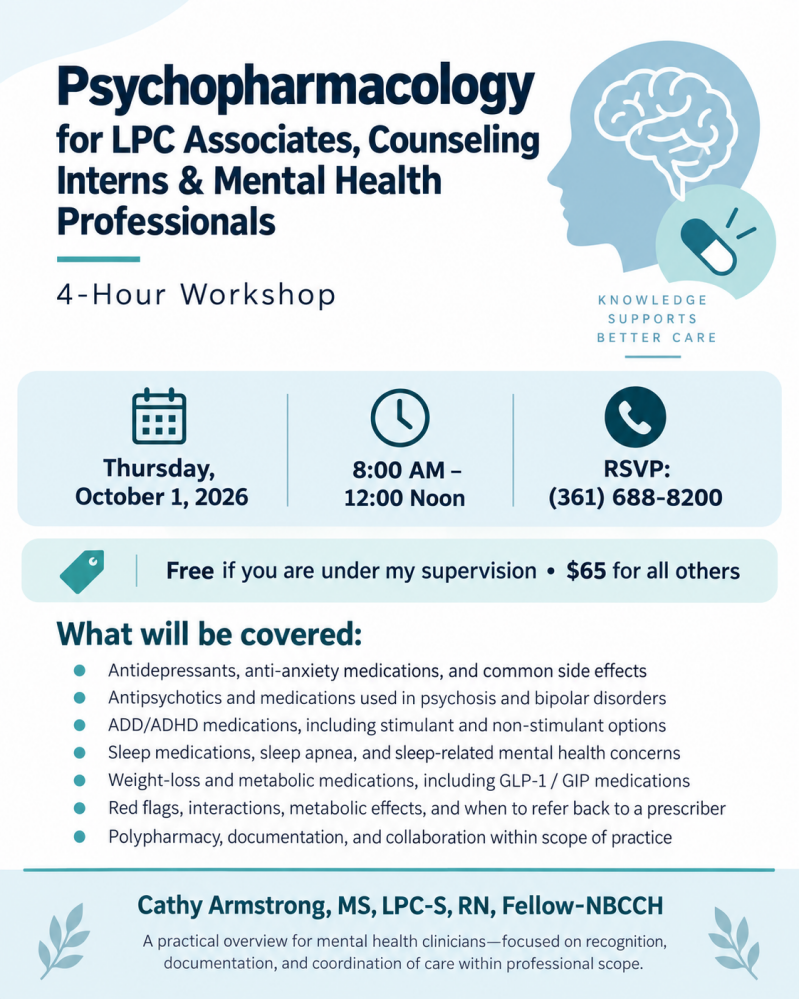
Workshops may include topics such as psychopharmacology, trauma-informed care, somatic approaches, nervous-system regulation, clinical documentation, ethics, risk management, differential diagnosis, private-practice skills, and other subjects counselors often need in the real world but may not have received extensively in graduate school.
Workshops, retreats, and continuing education for Texas LPC Associates
Traditional approaches such as EMDR, Internal Family Systems, somatic work, clinical hypnosis, and CBT can all be valuable. At the same time, no single method is the right fit for every client—or every clinician.
These workshops create room to think beyond one modality. We explore practical, trauma-informed, integrative ways to support the whole person while also caring for the clinician behind the work.
Participants can expect a blend of education, guided reflection, experiential learning, conversation, and restorative practices.
The goal is to leave with ideas you can use in your clinical work, a clearer sense of your own professional direction, and space to reconnect with yourself outside the demands of daily practice.

In-Person Integrative Trauma Treatment Workshop Corpus Christi
- An Advanced Clinical Workshop for LPC Associates
Integrating Somatic Therapy, Internal Family Systems, Brainspotting, Tapping, and EMDR-Informed Practice - Saturday, September 12 | 2:00 PM- 6:00 PM
- 6901 Holly Road, Corpus Christi, Texas
RSVP required — no walk-ins
To reserve your seat: 361-688-2002
This four-hour workshop is designed for LPC Associates who already have foundational familiarity with somatic therapy, Internal Family Systems (IFS), Brainspotting, tapping/EFT-informed techniques, and EMDR. It is an integrative learning experience focused on how these approaches can complement one another in the treatment of trauma, anxiety, nervous-system dysregulation, and persistent protective patterns.
This is not a basic training or certification course in EMDR, Brainspotting, IFS, tapping, or somatic therapy. It is a clinical integration workshop for practitioners who want a clearer, more confident way to decide what to use, when to use it, and how to move responsively among approaches while staying grounded in client readiness, consent, pacing, and scope of practice. EMDR basic training itself has formal instructional, supervised-practicum, and consultation requirements, so this workshop should be described as EMDR-informed integration rather than EMDR certification training.

Traum Training Workshop Focus
Trauma and anxiety rarely show up in only one way. A client may intellectually understand their patterns yet remain physiologically activated. Another may identify a protective “part” yet have difficulty accessing the body safely. Someone else may be ready for focused processing but become flooded, dissociative, avoidant, or disconnected during the work.
This workshop explores an integrative clinical question:
How do we listen simultaneously to the client’s body, nervous system, internal parts, attention, emotional experience, and readiness for processing?
Participants will explore how to blend somatic inquiry, parts-informed curiosity, focused attention, bilateral or tapping-based regulation strategies, and EMDR-informed clinical sequencing in a way that remains collaborative and responsive to the client’s moment-to-moment experience.
Brainspotting describes itself as a focused, brain-body treatment method centered on identifying and processing neurophysiological sources of emotional and bodily pain, trauma, dissociation, and other challenging symptoms. The IFS Institute describes a progressive professional-training path for clinicians who wish to become IFS therapists, reinforcing that this workshop is best positioned as an integration and application experience—not a substitute for model-specific training.[brainspotting +2]
Learning objectives
By the end of the workshop, participants will be able to:
• Identify clinical indicators that a client may benefit from stabilization, resourcing, parts work, somatic tracking, focused processing, or a return to grounding.
• Use an integrative trauma-informed inquiry sequence that attends to sensation, emotion, cognition, internal parts, attention, and client choice.
• Differentiate between activation, overwhelm, shutdown, avoidance, protective responses, and manageable therapeutic engagement.
• Explore how somatic tracking can support IFS-informed work with protectors, exiles, and Self-energy without forcing disclosure or emotional intensity.
• Discuss ways Brainspotting-informed focused attention may be paired with body awareness, resourcing, and titrated processing.
• Practice tapping/EFT-informed strategies as optional regulation and preparation tools within an integrative trauma-treatment framework.
• Apply EMDR-informed concepts of preparation, resourcing, target selection, dual attention, closure, and reevaluation without presenting this workshop as EMDR basic training.
• Develop language for inviting body awareness and internal inquiry while preserving consent, autonomy, and client pacing.
• Recognize when to pause, regulate, seek consultation, refer, or remain within the limits of one’s education, supervision, credentialing, and professional scope.

Core clinical framework
Pause → Notice → Inquire → Resource → Process → Integrate
Pause
Slow the pace. Notice what is happening for the client and within yourself as clinician.
Notice
Track body cues, breath, posture, gaze, tone, internal language, emotional shifts, attention, and signs of activation or disconnection.
Inquire
Use curiosity rather than interpretation:
• “What are you noticing in your body right now?”
• “Is there a part of you that has something to say about this?”
• “What happens if we stay with that sensation for just a moment?”
• “Would it be helpful to shift attention, slow down, or use a resource?”
• “What feels manageable enough to explore today?”
Resource
Support stabilization through orienting, grounding, bilateral self-tapping if appropriate, internal or external resources, safe-place imagery when appropriate, or connection to Self-energy and supportive internal parts.
Process
If the client has sufficient regulation, choice, and readiness, use the clinician’s appropriately trained model—somatic tracking, IFS inquiry, Brainspotting, EMDR, or tapping-informed interventions.
Integrate
Close intentionally. Reorient to the present, assess the client’s state, identify supports, and ensure the client leaves with enough regulation and clarity to transition safely.
Exercises and demonstrations
Embodied clinical check-in
Participants practice a brief pre-session self-check:
• What am I noticing in my own breath, posture, energy, and pace?
• Am I regulated enough to be present with another person?
• Is there anything I need to set aside, acknowledge, or resource before beginning?
• What would help me remain curious rather than urgent, rescuing, avoidant, or overly directive?
This supports the clinician’s use of self as an instrument of attunement.
Somatic inquiry practice
Participants work with a neutral or mildly stressful professional scenario rather than personal trauma content.
Suggested prompts:
• “Where do you notice that in your body?”
• “What is the quality of that sensation—tight, heavy, warm, moving, still, numb, buzzing, or something else?”
• “What happens when you simply notice it?”
• “Would you like to stay with that, or would you prefer to return to a more neutral place in your body?”
• “What would help you feel 5% more supported right now?”
The purpose is to practice tracking without assuming that a body cue has one fixed meaning.
Parts-and-body dialogue
Participants learn a basic integration sequence:
1. Identify a body sensation, emotion, impulse, or pattern.
2. Ask whether there is a “part” connected to that experience.
3. Invite curiosity toward the part rather than trying to eliminate it.
4. Explore the part’s protective intention.
5. Notice how the body responds when the part feels acknowledged.
6. Return to grounding, support, or a resource if intensity rises.
Example language:
When you notice the tightness in your chest, is there a part of you connected with that tightness?”
“How do you feel toward that part right now?”
“What does that part want you to know?”
“Would it be okay to thank it for trying to protect you, without asking it to change yet?”

Focused-attention demonstration
Using a non-trauma, low-intensity example, demonstrate how a clinician might help a client notice the relationship between visual focus, body sensation, and emotional activation.
Emphasize:
• The client determines whether they want to engage.
• The clinician does not force eye position, interpretation, or emotional release.
• The clinician watches for signs of activation, loss of dual awareness, overwhelm, or dissociation.
• The clinician returns to orienting, grounding, or resourcing when needed.
Tapping-informed regulation sequence
Offer tapping as an optional regulation tool, not as a required intervention or a universal solution.
Example low-intensity sequence:
Even though part of me feels tense as I think about this situation, I am here now, and I can go slowly.”
“I notice this tension.”
“I do not have to force anything.” “A part of me is trying to protect me.”
“I can be curious about what I need.”
“I can return to the present moment.”
Participants can choose to tap, press fingertips together, place a hand over the heart, feel their feet, or simply observe.

Case conceptualization lab
Give each small group a short vignette involving trauma and anxiety.
Ask:
• What is the client’s current nervous-system state?
• What signs suggest readiness or lack of readiness for processing?
• What protective part may be active?
• What somatic cues would you track?
• Would you begin with resourcing, parts work, focused attention, tapping, EMDR-informed preparation, or another intervention?
• What would tell you to slow down, pause, or return to stabilization?
• What is within your current training and supervision scope?
Reserve your space today
Step into an inspiring environment that honors the sacred dimension of your counseling work. All workshops and retreats are fully complimentary for LPC associates currently under my direct Texas supervision, with continuing education credits and welcoming spaces open to all visiting associates and clinicians. Reach out directly to cathyarmstronglpc@gmail.com or call (361) 688-8200 to reserve your spot.